
Greenwood City Directory Sources by Year
The confirmed starting place is the Lawrence Genealogy Room at the Greenwood County Library. Its research request form names a “Greenwood directory” category and says the oldest is 1908. The Library has not published a title-by-title run, a publisher sequence, or a verified list of reverse volumes. That makes the Greenwood collection useful, but it also means a researcher should ask for the exact years held instead of assuming each year survives. Greenwood special collections also include maps, archives, vertical files, local photographs, and genealogy material that can clarify a local directory result.
| Local source | Confirmed span | Custodian | Access route |
|---|---|---|---|
| Greenwood directory collection | Oldest confirmed: 1908 | Lawrence Genealogy Room | Catalog, staff list, or research request; exact later run needs verification |
| Greenwood Journal obituary index | 1895–1917 | Greenwood County Library | Online index and library microfilm/copy service |
| Greenwood Index obituary index | 1901–1919 | Greenwood County Library | Online index; 1906 papers are unavailable |
| Greenwood Index-Journal index | 1919–present | Greenwood County Library | Online index, local database, microfilm, or copy request |
| Federal census | Released through 1950 | Library databases and federal sources | Compare the census date and ward with other dated records |
These Greenwood sources overlap rather than form an annual, complete roll. A name missing in one Greenwood directory may reflect a move, a different spelling, a gap in surviving volumes, or an entry that was not printed. Record the Greenwood title page and page number before drawing a conclusion.
Greenwood Directories at the Library
The Lawrence Genealogy Room is on the second floor of the Greenwood County Library at 600 South Main Street. Its Greenwood special collections are in-library use. The library asks visitors to use a pencil, keep hands clean and dry, and leave food and drink out of the collection area. Cataloging is incomplete, so an unsuccessful catalog search does not end a Greenwood directory inquiry. Ask Greenwood staff about uncatalogued archive boxes, maps, vertical files, school or church material, and the directory shelf.
The Library's genealogy research request form shows the local records that can be requested, including the Greenwood directory collection, maps, archives, census records, pre-1900 deed books, and probate or will material.
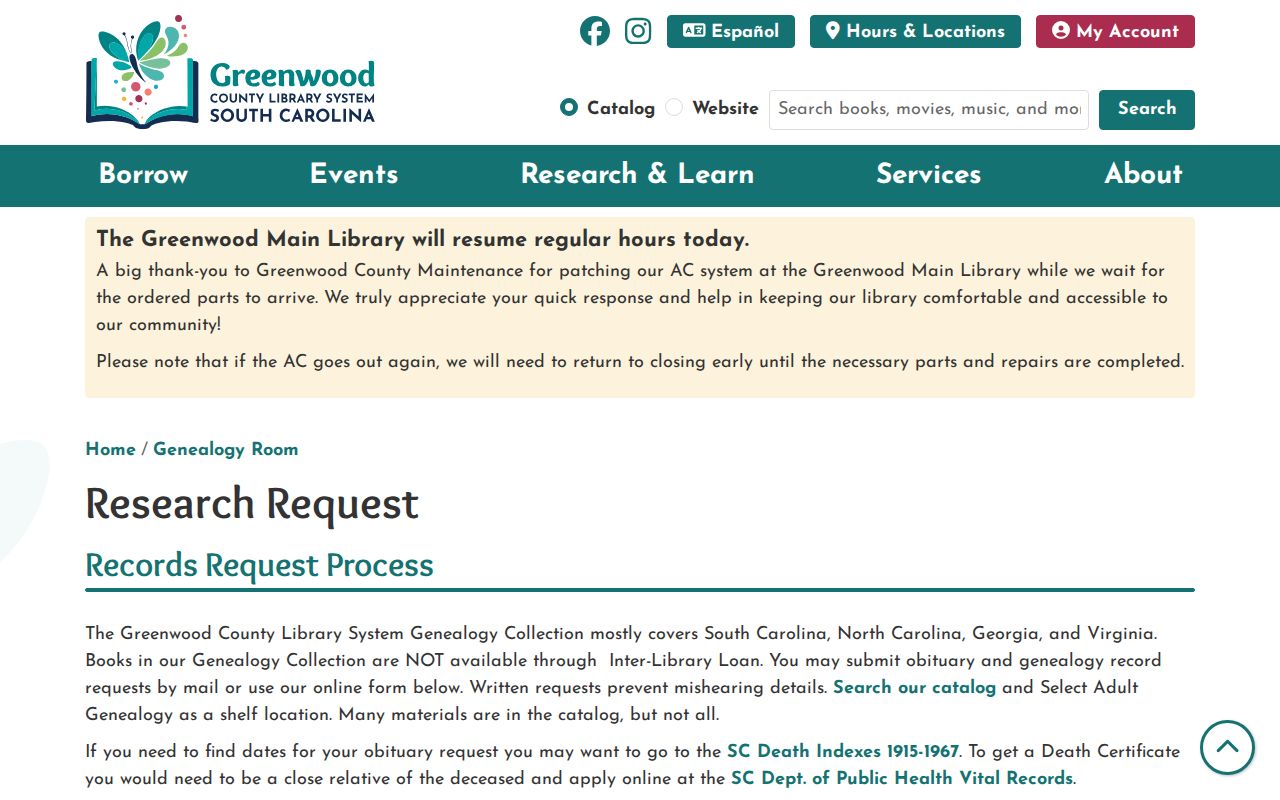
The request choices are a useful reminder to state the name as it appears in the Greenwood source, along with a date range, street, and record type rather than asking for a broad search. If the room is closed, staff may retrieve material for second-level use with photo identification or a current library card.
Greenwood Directory Gaps Matter
Only the 1908 starting point is confirmed in the inspected Greenwood sources. There is no published basis for naming a publisher, calling the run continuous, or saying that a criss-cross edition exists for a particular year. The right check is simple: request or examine the volume, copy its title page, and see whether it has a street-order section. If an old Greenwood address cannot be found, compare the street, cross streets, subdivision or lot description against a plat, map, deed, or newspaper item rather than treating the silence as proof.
Greenwood County was formed from Abbeville and Edgefield counties in 1897. For an earlier household or property event, a Greenwood directory volume will not solve the custody problem. The relevant land, court, or family record may instead sit with a parent county or a state-held collection. The South Carolina Department of Archives and History Greenwood County guide is the authoritative route for the surviving county record groups.
Note: A missing directory entry is a research question, not proof that a person never lived at the address.
Reading Greenwood City Directory Clues
No actual Greenwood directory line was available in the official sources reviewed, so a sample entry should not be invented. When an actual Greenwood volume is in hand, transcribe exactly what it prints. Historic directories often supply a name, initials, address, occupation or organization, and spouse or widow notation, but those features must be checked against that volume's key. Copy the year, publisher or title-page information, page, spelling, and every abbreviation before matching the person to another Greenwood record.
| Printed name | Copy surname, given name, initials, and spelling exactly as shown. |
|---|---|
| Street address | Record the full address and compare it with maps, deeds, and dated newspapers. |
| Family notation | Note a spouse or widow reference only when the actual entry prints one. |
| Work notation | Capture an occupation or organization only if the volume includes it. |
| Volume citation | Save the directory year, title page, page or image, and abbreviation key. |
- Criss-cross directory
- A street-order section that can group entries by address. Greenwood holdings and years are not published, so ask staff whether a requested volume has one.
- Householder index
- An index organized around the listed household or address. It is useful only after the volume itself confirms that format.
- Abbreviation key
- The volume's own explanation of shortened words and symbols. Photograph or transcribe it with the entry.
Greenwood Newspapers Extend Directory Searches
When a household drops out of a Greenwood directory, the Library's obituary and death-notice index can add a date, kin clue, or newspaper issue. It abstracts Greenwood Journal from 1895 to 1917, Greenwood Index from 1901 to 1919, and Greenwood Index-Journal from 1919 forward. Entries are organized by year and surname. A notice can be brief, so it is a lead to a microfilm or copy request, not a substitute for the complete issue.
Greenwood County Library's obituary index provides the name-and-date route into those Greenwood newspaper holdings.
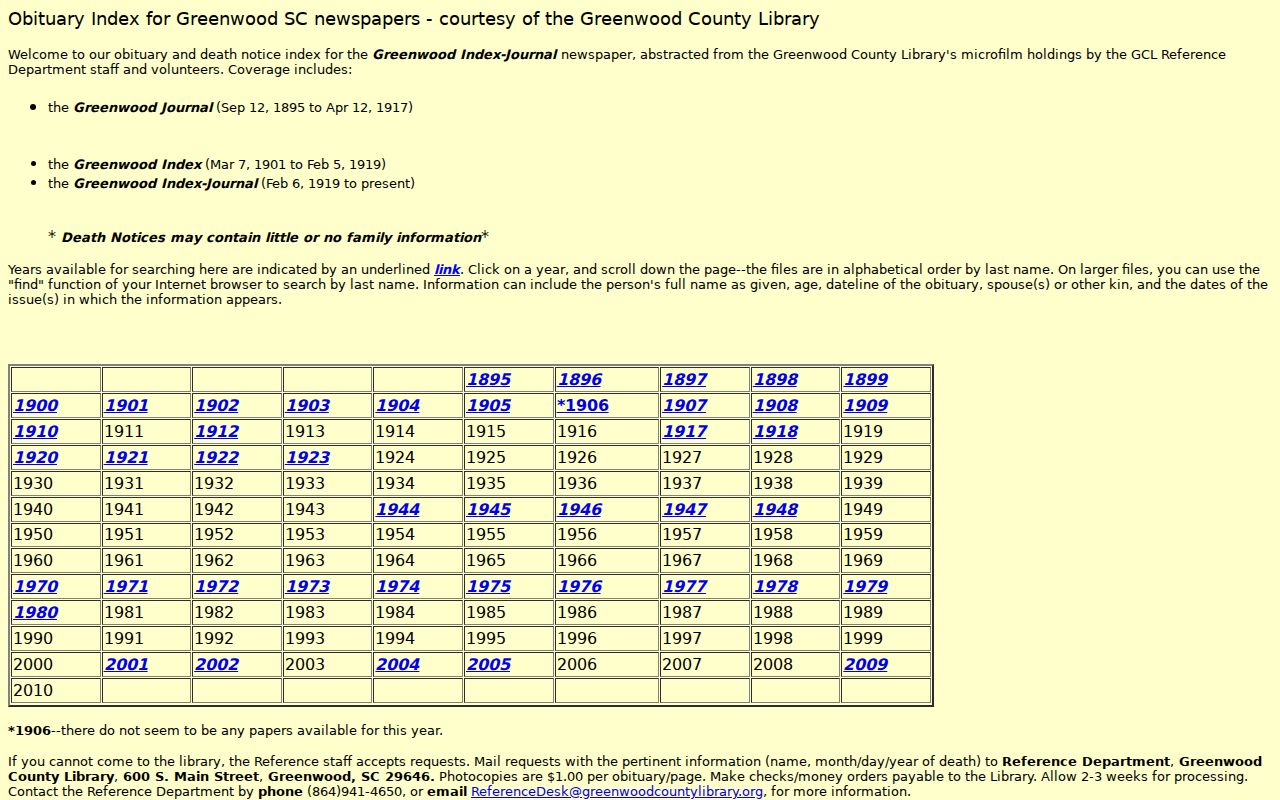
A full Greenwood date makes a request faster. The Library publishes a $1 per-page charge for a mailed or emailed obituary copy and asks researchers to allow two to three weeks. A day-by-day microfilm search is billed at $25 an hour plus copying, so a directory year and address can reduce the amount of searching needed.
The Greenwood County Library's history helps explain the local scope of its long-running archive, newspaper, and genealogy collections.
Major local-paper microfilm reaches from 1896 through 2018, although reader availability can be limited. Advance contact, the online obituary index, or a defined request are practical alternatives to relying on a walk-in search alone.
Greenwood Directories Meet Old Maps
A Greenwood directory gives a dated household lead. A Sanborn map can place that address within the built landscape. The Library of Congress provides free Greenwood Sanborn sets for 1884, 1889, and 1904. They can show street layout, building footprints, construction or use notation, and neighboring structures in the mapped area. They do not name a household or prove that a person lived at a given address.
Use a 1904 Greenwood Sanborn map with the 1908-or-later directory collection, then test the street and lot against recorded land material. This is particularly helpful where a modern street number does not match an older description. It is also an important local timeline: the maps predate Greenwood County's 1897 creation, while the first confirmed local directory reference comes later.
Trace Greenwood City Directory Households
Work from a dated Greenwood entry outward. The aim is to build a short, cited timeline, not to fill every missing year with a guess. Pair each available directory with the closest released census, an obituary date, a deed or plat reference, and a map where needed. The newer Greenwood directory shelves are not a substitute for current address research, and a residence notation never establishes every person connected to a home.
- Locate the earliest available Greenwood directory entry for the known name or address and copy its full citation.
- Check the next available issue, recording spelling changes, a new street, or a new family notation without assuming why it changed.
- Ask whether that volume contains a verified street-order section, then compare the printed address with the actual volume key.
- Pair the date with the closest released federal census, which currently reaches 1950, and check the ward or address carefully.
- Use an obituary, probate file, map, deed, or plat to test a move, death, or property connection suggested by the dated entries.
For an old home rather than a named person, the address-by-address method belongs in the Greenwood past residents resource. It uses the same historical shelf as one part of a documented deed, parcel, and map trail.
Greenwood Historical Record Endpoints
A later vital or probate record can help close a Greenwood historical trail, but access rules differ. The South Carolina Department of Public Health is the state custodian for birth, death, marriage, and divorce records. Greenwood Probate Court issues local marriage licenses and certified marriage-license copies. The Library says Greenwood marriage copies from 1911 forward are available through Probate, while DPH supplies the broader state route. A marriage or death event is a date-led cross-check, not proof of a person's address throughout the year.
DPH death-certificate information explains that death certificates become public after 50 years; the public death indexes for 1915 through 1967 are a separate starting point.
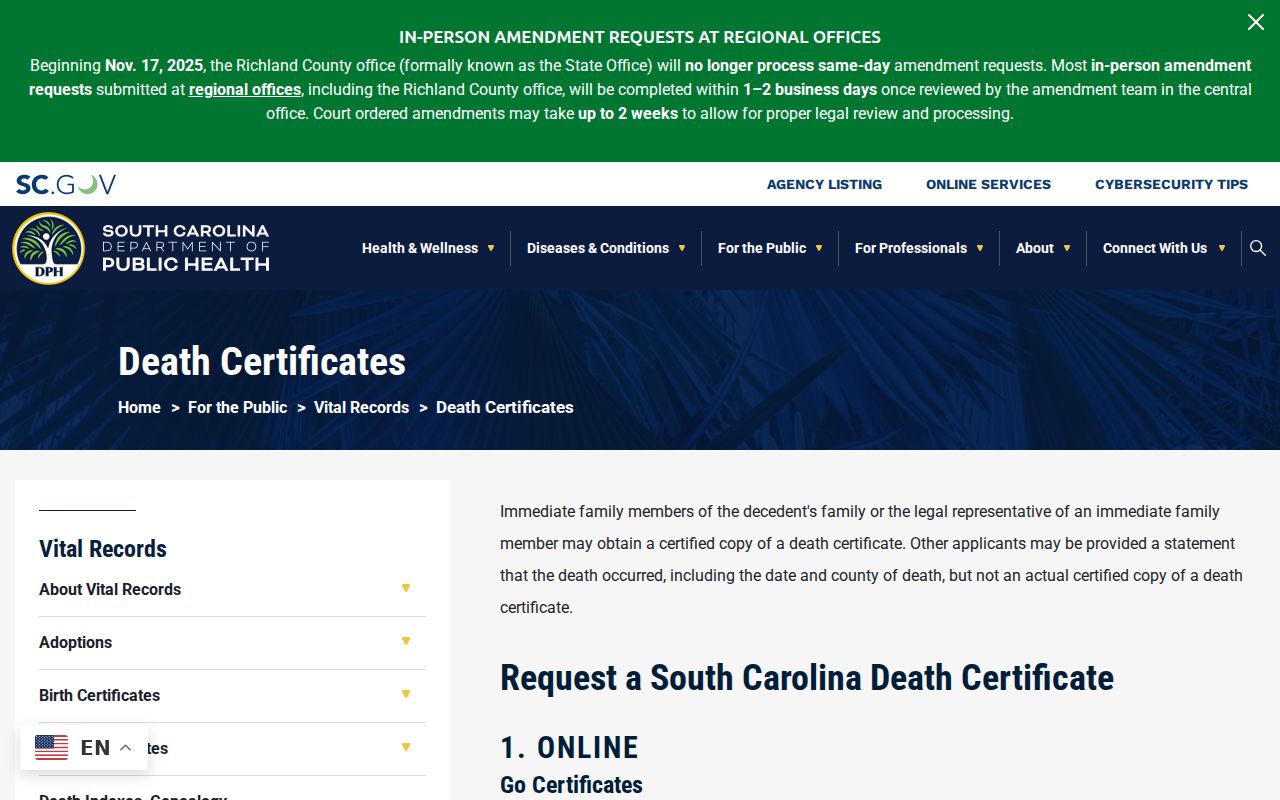
For a recent death, certified access remains limited until the public-record period. The obituary index, estate record, and dated city-directory entry may supply different pieces of the same historical question.
DPH marriage-certificate guidance sets out the state request channel and its eligibility distinctions.
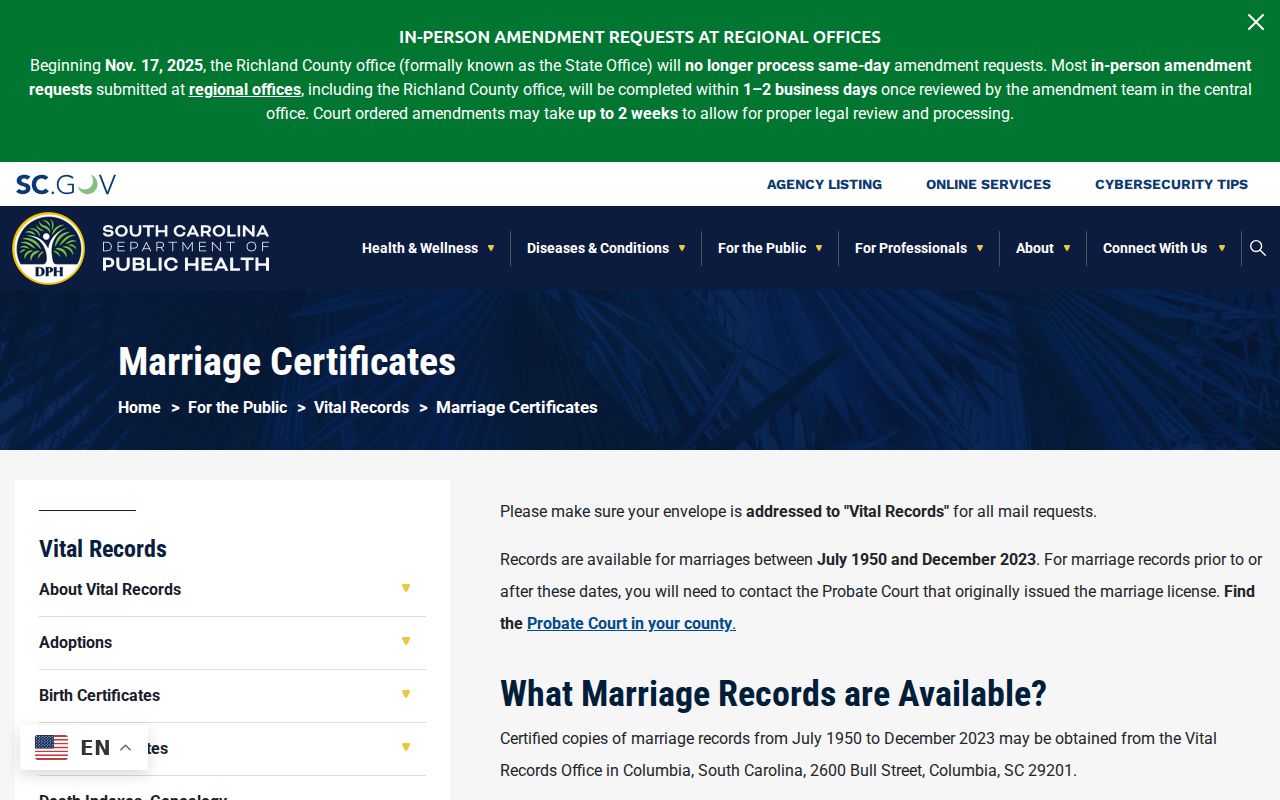
Other applicants may receive a statement of occurrence, date, and county rather than a certified marriage record. Keep that limited statement separate from the details printed in a local directory volume.
Greenwood Directory Requests From Afar
Remote Greenwood work is possible when the request is narrow. The Library's form asks for requester contact information, cost acknowledgment, a record type, an ancestor or subject name, and useful dates, places, and details. For an address inquiry, include the house number, street spelling, nearest cross street, requested time span, and known surname. The collection is not a promise of a complete household report. It is a staff-assisted route to identified material.
The Library lists $1 per page for emailed or mailed material, $0.20 per page picked up, and $25 an hour for in-depth research. More than five pages or in-depth work requires prepayment. Those boundaries help a researcher choose between an initial request, an in-library visit, or a more focused follow-up after a result identifies a year and page.
Note: Preserve the volume citation and date with every copied entry so another researcher can verify the same Greenwood source.