
Finding Greenwood Residents by Record
A Greenwood residents directory is a group of records, not one master list. Start with an address when the question concerns a parcel, a name when a recorded party or case is known, and a date when the goal is family history. Greenwood is the county seat, so the Clerk/ROD, Assessor, Probate Court, Tax Collector, and several court functions are concentrated near the courthouse area. The library supplies the historical layer through directories, maps, newspapers, and obituary leads. A result from one source should be treated as a lead until another dated official or archival source supports it.
Property ownership is not the same as current occupancy. A voter confirmation is personal rather than a public street roster. Court and vital material can also be restricted. That division keeps research focused and reduces same-name mistakes.
- Write down the complete name, a middle initial or suffix if known, and the approximate period being checked.
- For a property lead, establish the street, parcel or map number, and legal description through the Assessor, GIS, or ROD counter.
- Search the Greenwood records index by party, subdivision, document type, document number, or a sensible recorded-date range.
- Compare the result with a time-compatible Probate, court, obituary, or library directory lead.
- Use the relevant counter, library request, archives guide, or a scoped public-records request when the online route ends.
Greenwood Resident Record Custodians
Each Greenwood records office answers a different question. The Clerk/ROD preserves recorded land instruments and court functions. The Assessor handles valuation and parcel administration. Probate handles estates and marriage licenses. The library holds the local materials that make an older name or address useful. A county record may cover a geography larger than the City of Greenwood, so collect the jurisdiction as well as the name. For a full current address chain, use the Greenwood by-street directory after identifying the parcel.
Greenwood County Clerk/ROD
528 Monument Street, Room 114
Greenwood, SC 29646
864-942-8613
Greenwood County Assessor
528 Monument Street, Room 109
Greenwood, SC 29646
864-942-8537
Greenwood Probate Court
528 Monument Street, Room 205
Greenwood, SC 29646
864-942-8625
Note: The Clerk/ROD and Assessor are evidence sources for different facts, so an address search should not treat either office as a household roster.
Greenwood Deed Index Search Fields
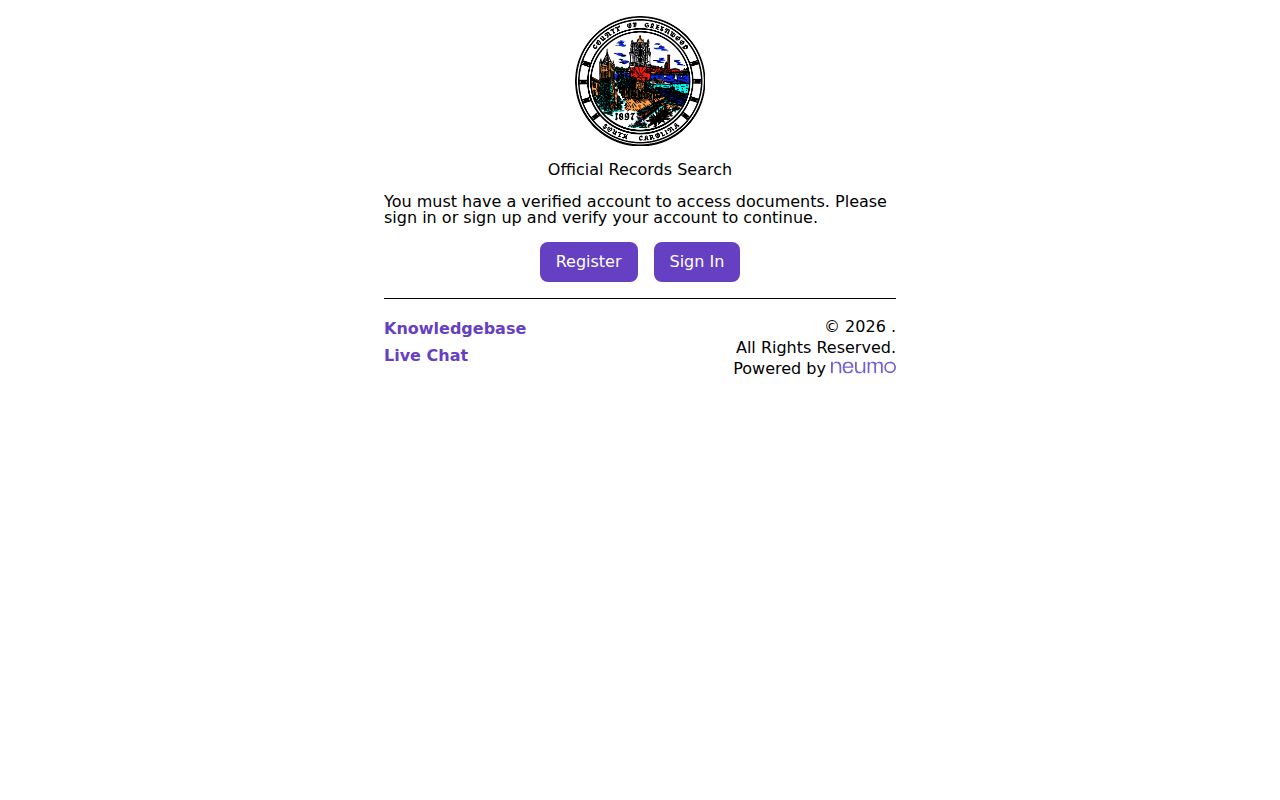
The public Greenwood Official Records Quick Search opens on its Real Property context. Its search box expressly accepts a grantor or grantee, subdivision, document type, or document number. Recorded-date filters help distinguish people with similar names. The visible form also separates indexed searching from full-text OCR searching. In the first mode, multiple words are searched individually in indexed information. In the OCR mode, multiple words are handled as a phrase inside document contents. That difference matters when a name may be a party entry rather than wording in an instrument.
| Greenwood field | Use | Important limit |
|---|---|---|
| Search Term | Grantor/grantee, subdivision, document type, or document number | Try spelling variants deliberately. |
| Recorded Date | From and to dates for a known period | Recent recording can lag online. |
| Relative date | Shortcuts from 24 hours through one year | Useful for recent filings, not history. |
| Index Only | Searches indexed information | Multiple words are separate terms. |
| Index and Full Text OCR | Searches document contents | Multiple words are treated as a phrase. |
The public landing screen does not state a first online-index year. Document access requires a verified account. A search-form result is therefore a lead, while a complete document or a counter check is the stronger record.
See the official Greenwood records search used for this index view.
The Greenwood residents directory workflow benefits from recording the search scope and date range before a party-name result is compared with another source.
Greenwood Parcel and Mailing Clues
A Greenwood property trail uses three labels that should stay separate. The situs address describes where a parcel is located. A mailing address is where assessment correspondence goes. The legal description identifies the property interest through a lot, subdivision, plat, or metes-and-bounds description. The Assessor’s mailing-address-change form and its map-number workflow make that distinction practical. A person can receive tax mail away from the parcel, while a resident may have no ownership interest at all.
- Parcel or map number
- An identifier used in the county’s property administration workflow.
- Situs address
- The physical street location of the parcel.
- Legal description
- The land description used to match instruments, plats, and lots.
- Recorded index
- A finding aid to recorded instruments, not a substitute for the document itself.
The official Assessor page describes valuation, classifications, legal-residence relief, parcel combinations and splits, but the research did not confirm a public owner-name search screen. Ask the Assessor or use the map view to clarify the appropriate parcel channel.
See the Greenwood County Assessor page for its stated property functions.
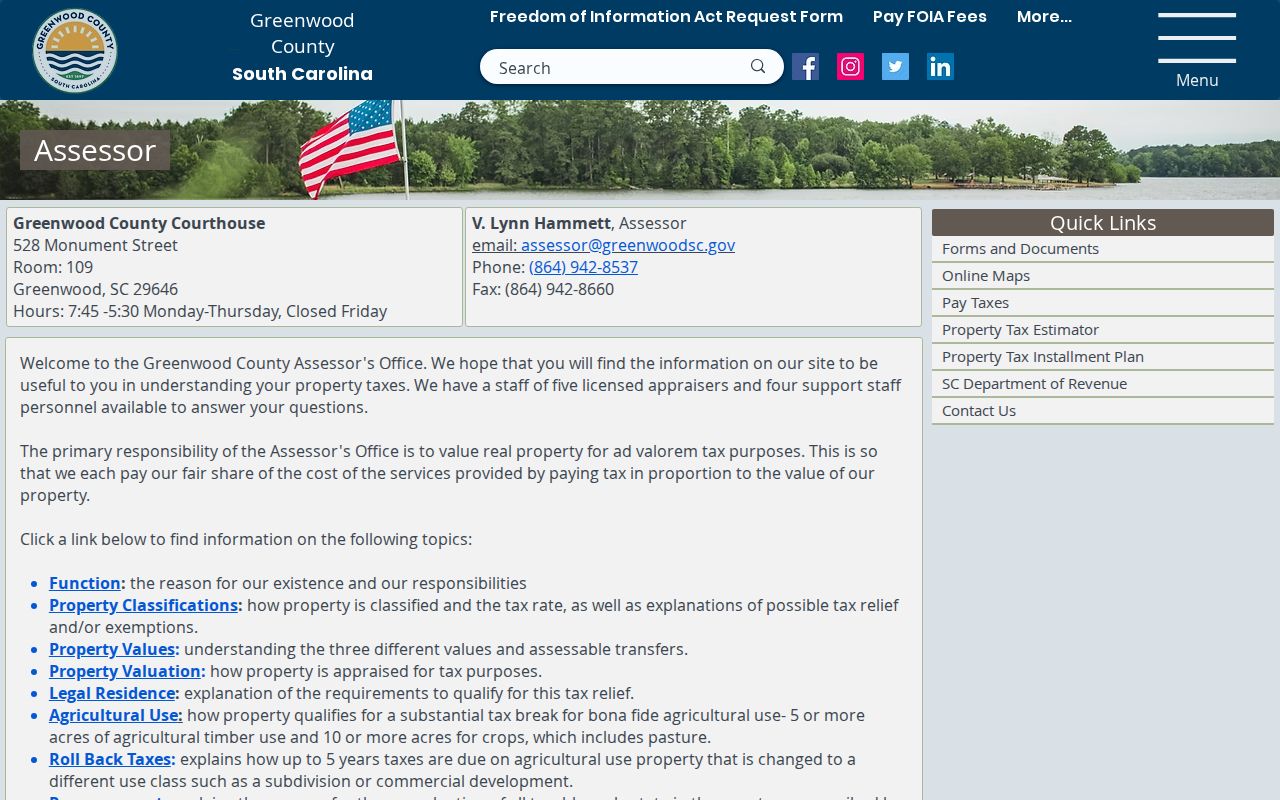
Assessment resources help put a record on the right parcel, but they do not establish every person living at that address.
Greenwood Voter Confirmation Limits
South Carolina’s MySCVOTES service is a personal confirmation tool. Check My Registration requires the voter’s name, county, and date of birth as it appears on the registration card. It is not a public browse-by-street directory. A complete voter-list product has a separate regulated purchase route for registered South Carolina voters under S.C. Code Ann. § 7-3-20(D)(13). The state’s access rules and use notice matter as much as the fields in a file.
| Personal lookup inputs | Name, county, and date of birth as shown on the registration card |
|---|---|
| What it is for | Checking an individual voter’s own registration information |
| Not verified here | A public address, ZIP, or block-browse function |
A missing online match can reflect an inactive record, data-entry difference, or a protected status. It is not proof that someone left Greenwood.
Greenwood Resident Directory Sources Today
Current Greenwood resident leads have different strengths. A recorded instrument can place a party in a land transaction. An estate file may identify a fiduciary or heir. A court result may show a party role, subject to access limits. The library’s obituary index can supply a date or kin clue. None should be stretched into proof of all present occupants. The table below matches a source to the narrow question it can answer.
| Source | What it can show | Custodian | Access route |
|---|---|---|---|
| Recorded land index | Parties, land-instrument trail, dates | Clerk/ROD | Public search, verified document account, or counter |
| Parcel administration | Assessment and map-number context | Assessor | Office resources, GIS, or counter inquiry |
| Estate and marriage records | Filed estate role or local license channel | Probate Court | Portal links and court counter |
| Registration confirmation | Personal voter-registration check | State Election Commission | MySCVOTES identity inputs |
| Obituary index | Published death-notice and kin leads | Greenwood County Library | Online index, microfilm, or research request |
A commercial compiled directory can be convenient, but old addresses and same-name matches need primary-source verification. Official records, the library, and the actual custodian provide the better evidence trail.
Greenwood Courts and Probate Roles
Greenwood County is in the Eighth Judicial Circuit. The Clerk maintains General Sessions, Common Pleas, Family, and Juvenile materials, while Probate Court handles estates, guardianships, conservatorships, and local marriage licenses. The Judicial Branch Greenwood gateway routes a searcher to the relevant court. The statewide trial-court endpoint did not load in the research environment, so its live party and case fields should not be assumed. The separate FCCMS portal serves public Family Court cases, but confidential matters do not populate.
A docket entry should be confirmed against the correct division, case number, party role, filing date, and status. The Clerk offers public terminals and index books, although staff do not perform research or give specific case details by telephone.
See the Greenwood County Clerk of Court page for the court functions and counter access.
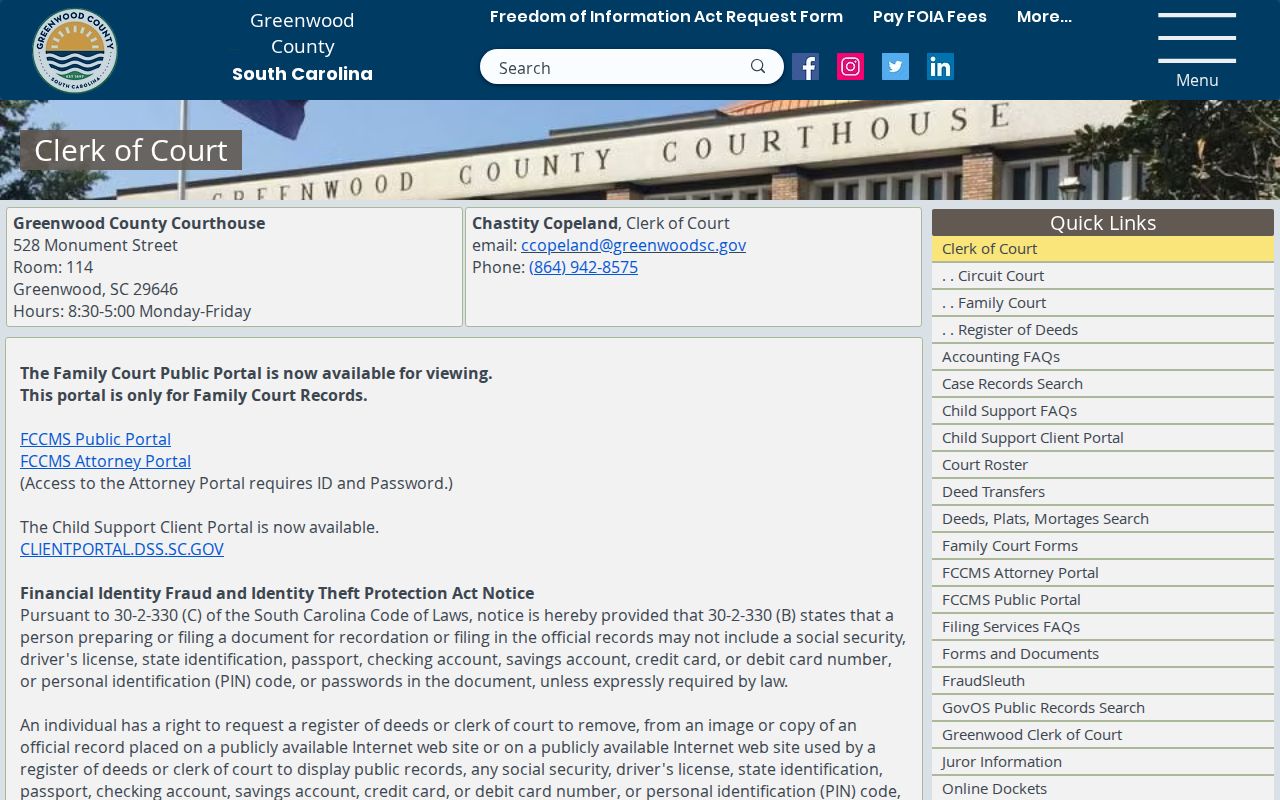
The Clerk is a local access point for court and recorded-land channels, yet the appropriate division still determines what a case search can reveal.
Greenwood Probate and Vital Paths
Probate provides the local path for estate matters and marriage licenses. The County Library’s genealogy FAQ states that Greenwood County certified marriage-license copies from 1911 forward are available through Probate, while state custody and eligibility rules control other vital-record requests. The South Carolina Department of Public Health is the statewide custodian for birth, death, marriage, and divorce certificates. Death certificates become public after 50 years, and births after 100 years, subject to the statutory process. The state’s death indexes for 1915 through 1967 are an index route, not a certificate substitute.
For a current case or certificate question, use the named custodian and its live requirements. Restricted births, sealed adoptions, confidential family files, and other protected records are not ordinary directory material.
See the Greenwood Probate Court page for its estate and marriage gateways.
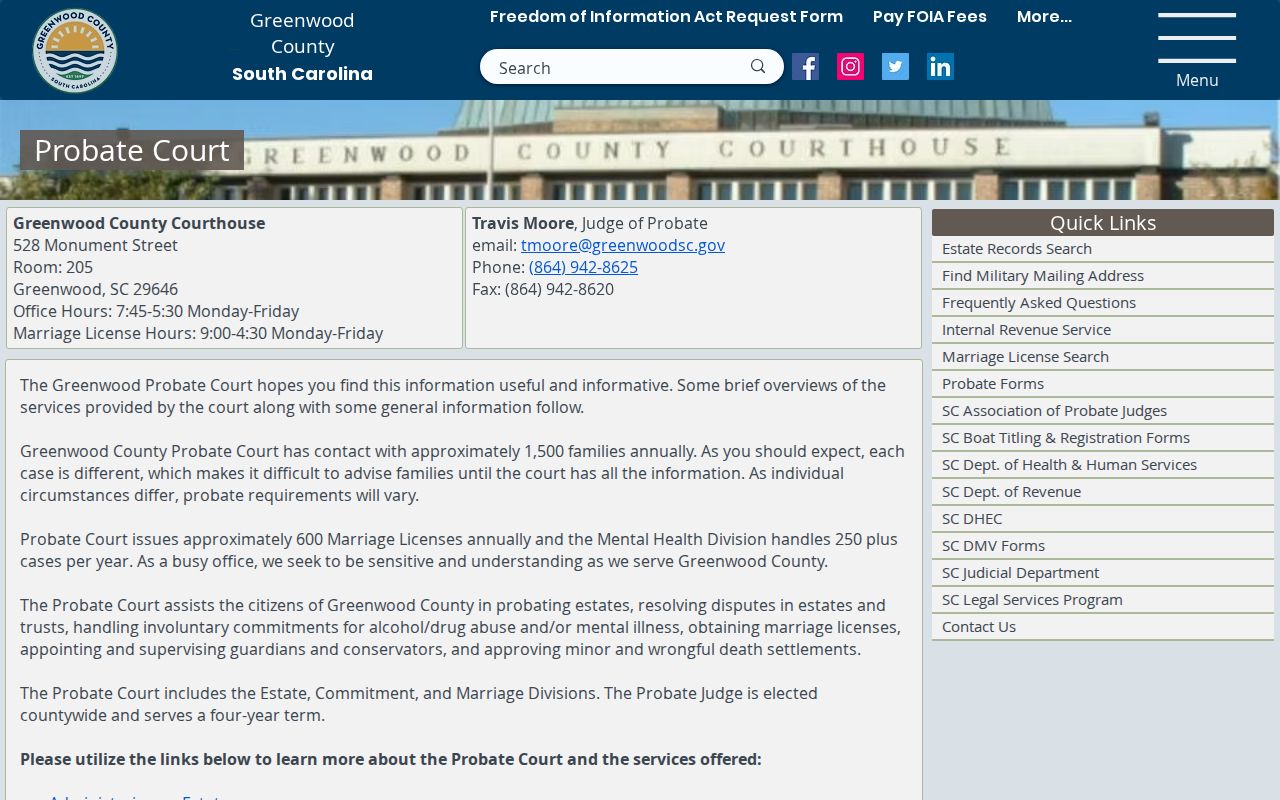
Probate can add a dated estate or marriage lead to a Greenwood residents directory search without turning a restricted vital record into an open listing.
When Greenwood Records Stay Offline
Online search is only one access channel. Greenwood’s ROD documents may require account verification to open, and recent ROD or Common Pleas items delivered after 4 p.m. can take up to one work week to appear online. The Clerk/ROD counter has public terminals and index books. For an older land trail, the South Carolina Department of Archives and History lists Greenwood RMC conveyance books for 1899 to 1923, master’s books for 1904 to 1923, and plat books for 1912 to 1945 on microfilm.
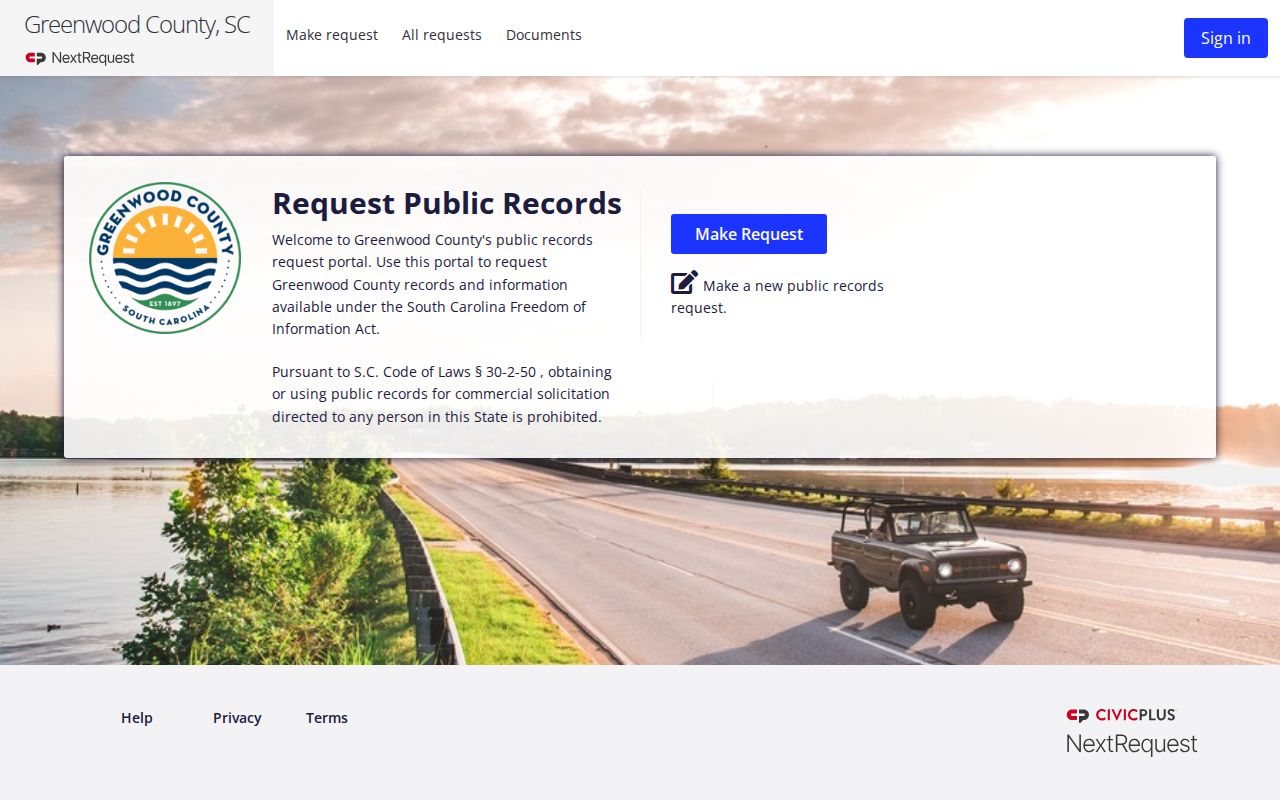
The South Carolina Freedom of Information Act offers a route to existing nonexempt county records that are not online. A narrow request through Greenwood County NextRequest should name the custodian, address or parcel, date span, and record category. It should request a cost estimate. The public body does not have to create a new record, and protected material can be withheld or redacted.
See the Greenwood County public-records request portal used for the request route.
A bounded request for an existing file is more likely to reach the right Greenwood records custodian than a broad request about a person.
Greenwood Library Family Leads
The Lawrence Genealogy Room at Greenwood County Library is the local historical counterweight to a contemporary index. Its special collections include city directories, maps, archive boxes, vertical files, local newspapers, school and church material, family-history boxes, and uncatalogued photographs. Materials are generally for in-library use. If the room is closed, staff may retrieve materials for second-level use with photo identification or a current library card. Many special items are not fully catalogued, so a specific request to staff can be more useful than a broad keyword search.
The online obituary/death-notice index covers the Greenwood Journal from 1895 to 1917, the Greenwood Index from 1901 to 1919, and the Index-Journal from 1919 forward. It flags 1906 as unavailable. An entry is a lead to a newspaper notice or microfilm, not a certificate record.
See the Lawrence Genealogy Room used for these local collection details.
Library holdings make it possible to place a Greenwood household in a specific era before comparing it with land, probate, or archive evidence.
Greenwood Records Before County Formation
Greenwood County was formed from parts of Abbeville and Edgefield counties in 1897. That date changes the starting point for early family and property research. A pre-1897 person or parcel may be recorded under a parent county rather than missing from Greenwood. The State Archives guide also uses the earlier Register of Mesne Conveyances, or RMC, terminology for land groups. Greenwood’s office changed from RMC to Register of Deeds on January 1, 1998, so both names describe the local land-record lineage in different periods.
Sanborn maps for Greenwood survive for 1884, 1889, and 1904. They can help align an old street clue with a building or block, but a map dates the physical setting rather than proving a household. The first confirmed Greenwood city-directory lead is a 1908 volume at the library.
Historical Greenwood Resident Directories
For an older household, a Greenwood city directory, local newspaper notice, map, and deed chain each answer a different part of the question. The library’s research-request form identifies “Greenwood City Directory (Oldest is 1908)” as a category, and its request service can also address obituaries, maps, archives, pre-1900 deeds or probate, and census material. Individual requests are limited to two per month and 30 minutes, so a surname, address, record type, and date window matter.
The full collection and entry-reading method is kept with the Greenwood city-directory collections. Here, the key point is to pair dated sources rather than assume an undated name hit identifies one household across decades.
Greenwood Privacy and Lawful Research
Public availability has real limits. South Carolina’s Address Confidentiality Program gives qualifying victims a substitute government-record address, and its application materials are confidential. Since January 1, 2026, Article 7 of Title 30, Chapter 2 also provides a route for eligible active or former law-enforcement and corrections officers to seek restrictions on defined personal contact details in online displays. Those rules do not make every government record disappear, but they do mean an absent or changed address field must be respected.
The Family Privacy Protection Act restricts commercial solicitation using personal information acquired from state or local public records. If an online image appears to expose sensitive data, preserve only the page or instrument reference needed to alert the Clerk/ROD rather than copying the information.